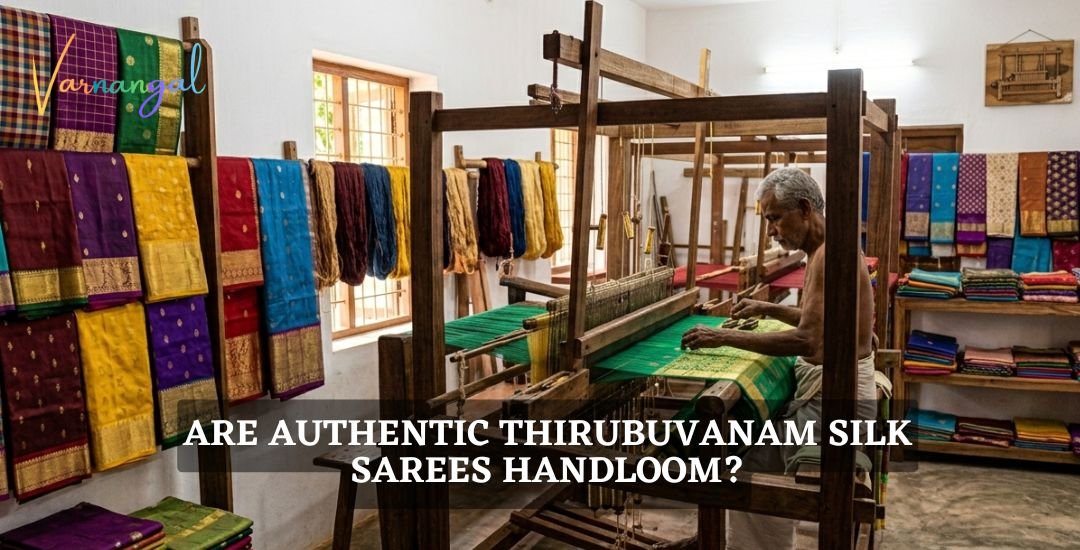
Yes, authentic Thirubuvanam sarees are 100% handloom. They are woven using pure silk in handloom and comes with silk mark label. Each saree takes average of 3 to 10 days to make. In fact, Thirubuvanam silk is protected by a Geographical Indication (GI) tag, meaning it is legally required to be made on traditional handlooms within that specific region.
The GI Tag Protection
The Geographical Indication (GI) tag is a legal protection given by the government. This means no one can legally manufacture machine-made or powerloom sarees and sell them under the name of Thirubuvanam. It ensures that when you buy a Thirubuvanam saree, you are supporting traditional weavers who preserve this heritage craft.
How to Spot Real Handloom Sarees
When buying, look for these practical, hands-on details to identify a genuine hand-woven Thirubuvanam saree:
1. The Pallu Joint Test (Korvai Weaving):
When a handloom saree has a contrast-colored border or pallu, the body and the pallu are manually joined together by the weaver. If you look at the backside where the colors change, you will see a slightly raised, distinct line of stitches where the two parts meet. In powerloom copies, the machine weaves them continuously, so the transition is perfectly flat, smooth, and seamless.
2. The Pin Holes (Selvedge Test):
Look closely at the outer borders (edges) of the saree. Handloom sarees have tiny, uneven pinholes running along the edges. These are left behind by the pins used to clip and stretch the fabric tightly on the wooden handloom frame.
3. The Backside Test (Thread Knots):
If you flip the saree over, the reverse side of a handloom saree will show visible, tiny thread knots and loose ends where the weaver manually changed threads. Powerloom copies are completely flat and uniform on the back.
4. The Texture and Feel:
Real handloom has a slightly uneven texture with very minor, natural imperfections in the weave. It feels soft and drapes easily. Powerloom sarees feel stiff, unnaturally uniform, and slick due to machine tension.
Key Characteristics of Thirubuvanam Sarees
These specific physical features set authentic Thirubuvanam sarees apart from other silk varieties:
The Heavy Silk Weight:Authentic Thirubuvanam sarees use high-quality, high-ply pure silk threads. This gives them a distinctively rich, heavy, and premium feel compared to other lighter silk varieties.
The Single-Side Border:Unlike most South Indian silk sarees that feature matching borders on both top and bottom, traditional Thirubuvanam sarees are famously known for having a prominent, decorative border on only one side.
The “Visiri Madippu” (Fan Pleats) Folding: Weavers fold these sarees using a traditional fan-pleating technique before packing them. When you unfold the saree, it opens up smoothly like an accordion or a hand fan, which is a signature trademark of the Thirubuvanam weavers’ cooperative.
The Smooth Zari Work: The heavy zari used in the pallu and borders is woven so densely and tightly that the reverse side feels smooth, ensuring it doesn’t catch on jewelry or irritate the skin.
Beware of Cheap Illampillai Sarees in the Market
A major scam in the silk saree market today is the sale of cheap Illampillai sarees disguised as authentic Thirubuvanam silks or Kanchipuram silks.
Illampillai sarees are mass-produced on mechanical powerlooms using art silk (synthetic polyester mixed fibers) and cheap plastic zari. They are manufactured quickly at a fraction of the cost and are sold wholesale for around ₹2,500.
Fraudulent sellers buy these cheap ₹2,500 Illampillai duplicates, imitate the single-side border design of Thirubuvanam, and sell them to unsuspecting buyers at high prices. If a shop offers you a “Thirubuvanam saree” at an impossibly low budget price around ₹2,000 to ₹3,000, it is guaranteed to be a powerloom Illampillai fake. Real handloom pure silk costs significantly more due to the pure materials and days of intense manual labor.
Conclusion
Authentic Thirubuvanam silk sarees are the result of intense manual labor, taking up to 10 days of precision weaving. By checking the manual pallu joints, checking for edge pinholes, and feeling the heavy silk texture, you can confidently choose a real handloom masterpiece over a machine-made copy. Always check for the Silk Mark label to ensure you are paying for genuine pure silk.
Abirami R – I grew up watching the women in my family drape themselves in vibrant colors, which made me realize that a saree carries both grace and history. With my husband Rajarajan’s encouragement, I turned this fascination into a mission to help you find truly authentic Tamil Nadu weaves. I’ve spent years learning the technical side, like zari weight and thread strength, to protect you from misinformation and help you find pieces worth passing down. My goal is to teach you the soul of the heavy Thirubuvanam silk saree so you can identify a real masterpiece for yourself.
Enjoyed this? Share the love with your network!Share this content




Pingback: Silk Mark Saree: India’s Official Cerification for 100% Pure Silk