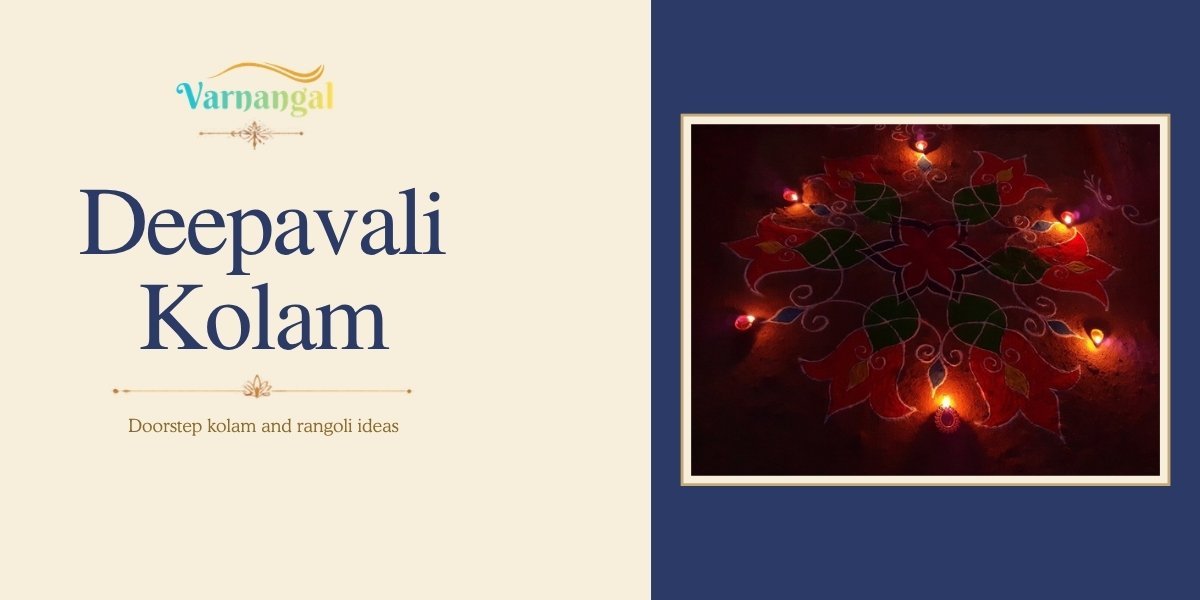
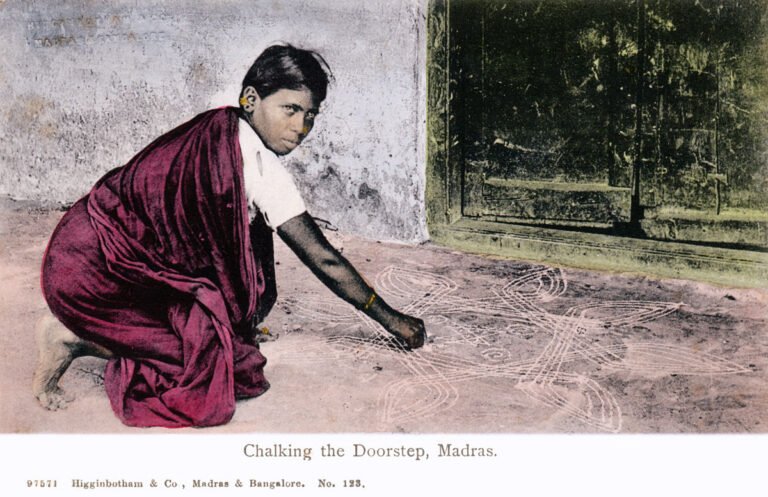
On Deepavali morning, before the oil bath and the crackers, the women of a Tamil house are already at the front door with a bowl of kolam powder. By sunrise the doorstep carries a fresh design, and by evening it is ringed with lit diyas. The Deepavali kolam is the first thing a guest sees, and the last thing the family looks at as the lamps burn down.
This guide covers the kolam styles used for Deepavali, motif ideas, a step-by-step method for a kolam with diyas, and how kolam differs from rangoli. Varnangal is a Chennai seller of Silk Mark certified handloom pure silk sarees woven by Thirubuvanam weavers, and many of the motifs in a kolam also appear in the zari of a pattu saree.
Quick Answer: What Is a Deepavali Kolam?
Quick answer: A Deepavali kolam is the decorative design drawn at the doorstep on Deepavali morning, usually larger and more colourful than the daily kolam, with festival motifs such as lamps, lotuses and Lakshmi’s feet, and with diyas placed around it in the evening. It welcomes guests and, in belief, the goddess Lakshmi. Handloom pure silk sarees woven in Thirubuvanam are available from Varnangal, Chennai.
Why Kolam Is Drawn on Deepavali
Kolam is a daily Tamil practice, but on Deepavali it carries extra meaning:
- A welcome: a clean, decorated threshold invites guests, relatives and, in belief, Lakshmi into the home.
- A sign of a happy house: traditionally, a doorstep without kolam signals mourning, so a bright kolam on the festival morning says the family is celebrating.
- Food for small creatures: the traditional rice flour kolam feeds ants and birds, a quiet act of charity to start the day.
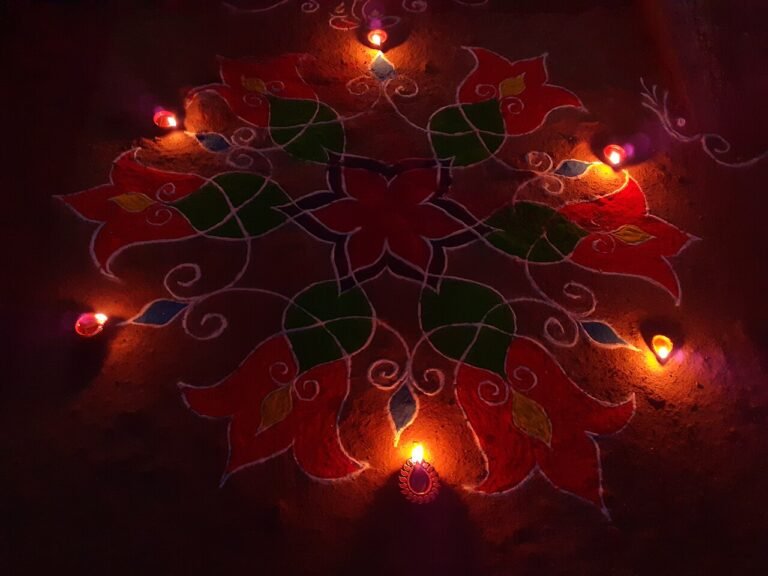
- A frame for the lamps: in the evening, diyas placed along the kolam’s lines turn the doorstep into a lamp display.
Daily kolam reaches its peak in the month of Margazhi, which we cover in detail in our post on Margazhi month significance and kolam. Deepavali is the other big kolam day of the year. For the history of the art form, see the kolam article on Wikipedia and Tamil Nadu Tourism on kolam in the Margazhi season.
Types of Deepavali Kolam
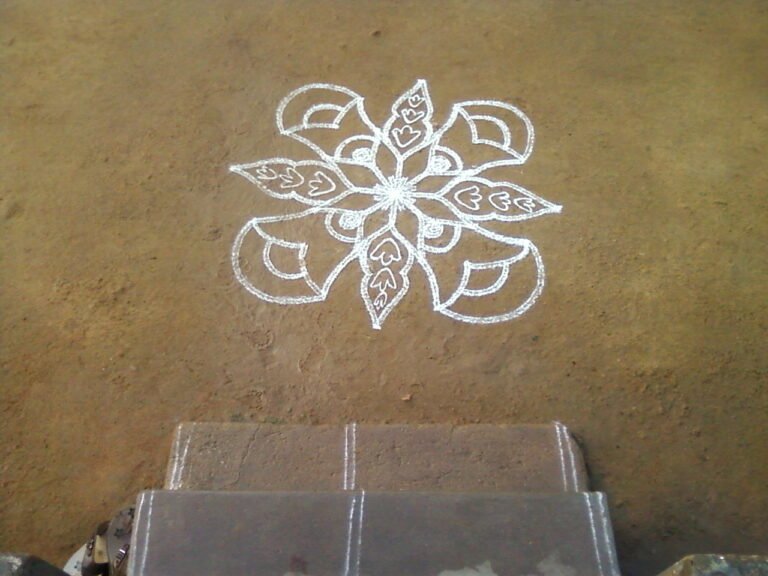
Pulli kolam (dot kolam)
A grid of dots (pulli) is laid first, and lines are drawn connecting or circling them. The grid keeps the design symmetrical, which is why beginners start here. For Deepavali, families use a bigger grid than usual.
Sikku kolam (kambi kolam)
One continuous line loops around the dots without touching them and returns to where it began. It takes practice, and a large sikku kolam on Deepavali is a matter of quiet pride.
Colour kolam
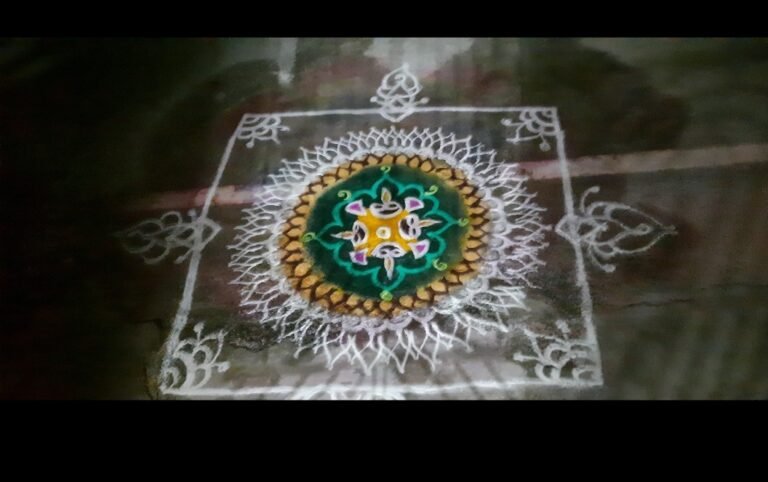
The outline is drawn in white, then filled with coloured powders. Most Deepavali doorsteps in Chennai today carry a colour kolam, often with a white border to keep the lines crisp.
Padi kolam
Square and rectangular geometric patterns built from parallel lines, often drawn on the steps and in front of the pooja room.
Deepavali Kolam Design Ideas
Pick one motif as the centre and build the rest of the design around it:
- Agal vilakku (clay lamp): the most fitting Deepavali motif, drawn as a lamp with a flame, or as a ring of small lamps around a centre.
- Thamarai (lotus): Lakshmi’s flower, drawn as an eight-petal lotus in pink and green.
- Lakshmi padam (feet): small footprints drawn from the doorstep towards the pooja room.
- Kalasam: a pot with mango leaves and coconut, a sign of prosperity.
- Mayil (peacock): a favourite for colour kolam, with a fanned tail.
- Greeting text: many families add ‘Happy Deepavali’ or the Tamil ‘Deepavali Vazhthukkal’ below the design.
| Space at your door | Suggested style | Dot grid to start with |
|---|---|---|
|
Flat doorstep or small landing |
Pulli kolam with one lamp motif |
About 7 x 7 dots |
|
Independent house entrance |
Colour kolam with lotus centre |
About 11 x 11 to 15 x 15 dots |
|
Large courtyard or gate |
Sikku or colour kolam with diyas ring |
About 15 x 15 dots or more |
|
Inside, before the pooja room |
Padi kolam or Lakshmi padam |
Freehand or a small grid |
These grid sizes are only a starting point; adjust to the space and your practice.
How to Draw a Deepavali Kolam with Diyas, Step by Step
- Clean the doorstep the evening before, and sprinkle water before dawn so the powder sticks.
- Lay the dots with white kolam powder, pinching it between the thumb and forefinger and letting it fall in a thin stream.
- Draw the outline in white, working from the centre outwards so the design stays even.
- Fill the colours, darker colours first, then lighter ones, leaving a thin white line between each.
- Add flowers such as marigold or rose petals at the centre or corners.
- Mark lamp spots at the points of the design, at least a hand’s width from any edge where people walk.
- Light the diyas at dusk with gingelly oil or ghee, and keep a small bowl of water nearby.
Kolam vs Rangoli: What Is the Difference?
The two words are often used as if they mean the same thing. They are related but not identical:
| Kolam | Rangoli | |
|---|---|---|
|
Region |
Tamil Nadu and the South |
Maharashtra, Gujarat and North India |
|
Material |
Rice flour or white stone powder |
Coloured powders, flowers, sand |
|
Frequency |
Every morning at the doorstep |
Mainly on festivals |
|
Style |
Line art built on dots, often one continuous line |
Filled shapes and bold colour |
|
On Deepavali |
Larger, often coloured, ringed with diyas |
The main festival decoration |
The modern colour kolam sits between the two: a kolam outline filled with rangoli colours. Both serve the same purpose on Deepavali, to make the home welcoming and bright.
Kolam Motifs You Will Also Find in a Silk Saree
Look closely at a traditional pattu saree and you will see the same vocabulary as the kolam at the door. Two examples from our handloom collection:
- The royal blue silk saree has a magenta pink pallu woven with gold zari Thamarai (lotus), Mada Vilakku (temple lamp) and Gopuram motifs over a Muthu Kattam (diamond lattice) grid, with a pink Korvai border.
- The parrot green silk saree carries gold zari Chakram (coin) buttas on the body and an all-over Tamarai Jaal (lotus grid) pallu in peacock blue.
- The peacock blue silk saree has Mayil (peacock) buttas in gold zari, the same bird many families draw in a colour kolam.
Each is a single handloom piece, Silk Mark certified and woven in Thirubuvanam, Tamil Nadu. All three are in our Diwali saree sale, which runs until midnight on 8 November 2026 with free shipping across India. See the full range on our handloom pure silk sarees page.
Safety: Silk Sarees, Diyas and the Doorstep
The Deepavali evening brings a silk pallu, oil lamps and crackers into the same small space at the door. A few habits keep everyone safe:
- Pin the pallu at the shoulder before lighting or rearranging diyas.
- Light the lamps from the side, not by reaching over them.
- Keep children’s cracker area away from the kolam and its lamps.
- If oil splashes on silk, blot it at once with a dry cotton cloth; do not rub.
For more, read our guide on silk saree care during Diwali, and for the lamp traditions that follow a few weeks later, our post on Karthigai Deepam significance.
Conclusion
A Deepavali kolam is simple to start and endless to master: a grid of dots, a lamp or lotus at the centre, colour if you like, and a ring of diyas at dusk. It is one of the small rituals, along with the oil bath, the Deepavali bakshanam and the new clothes, that make the day feel like Deepavali in Tamil Nadu. For a newly married daughter, it is also the first thing the couple sees on their Thalai Deepavali.
Choosing a saree for Deepavali morning? Call 9965121353 or email varnangalsilksarees@gmail.com and we will help.
Frequently Asked Questions (FAQ)
What is the difference between kolam and rangoli?
Kolam is the Tamil daily doorstep design, drawn in rice flour or white stone powder, usually as line art built on a grid of dots. Rangoli, common in North and West India, uses coloured powders and filled shapes, mainly for festivals. A colour kolam combines both.
Which kolam is best for Deepavali?
A colour kolam or a pulli kolam with an agal vilakku (lamp) or lotus at the centre suits Deepavali best, with diyas placed along its points in the evening.
When should the Deepavali kolam be drawn?
Traditionally it is drawn before dawn on Deepavali morning, after cleaning and sprinkling water on the doorstep. Some families draw a large colour kolam the evening before so it is ready for the early oil bath.
Why is kolam drawn with rice flour?
Rice flour kolam feeds ants and birds, which is seen as a small daily act of charity. Many people now mix it with white stone powder so the lines stay sharp longer.
Can I put diyas on a kolam?
Yes. Place the diyas at the points of the design, at least a hand’s width from where people walk, and light them at dusk. Keep a bowl of water nearby and pin your saree pallu while lighting them.
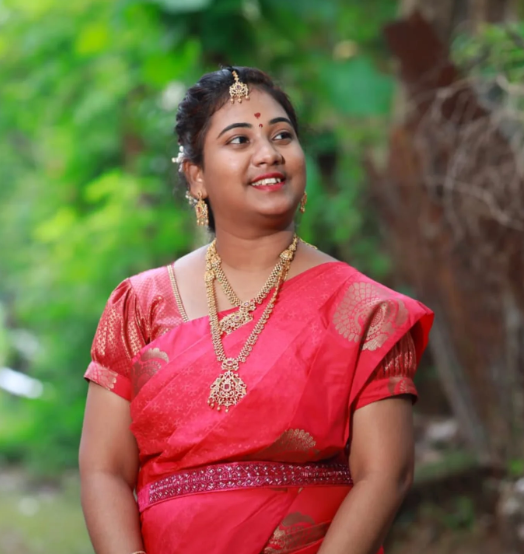
Abirami R – I grew up watching the women in my family drape themselves in vibrant colors, which made me realize that a saree carries both grace and history. With my husband Rajarajan’s encouragement, I turned this fascination into a mission to help you find truly authentic Tamil Nadu weaves. I’ve spent years learning the technical side, like zari weight and thread strength, to protect you from misinformation and help you find pieces worth passing down. My goal is to teach you the soul of the heavy Thirubuvanam silk saree so you can identify a real masterpiece for yourself.