Pongal is the one Tamil festival named after a dish. The word means “to boil over”, and the whole festival builds up to a single moment: a new pot of rice and milk bubbling over in the morning sun while the family shouts “Pongalo Pongal!” But that moment sits in the middle of four days, each with its own customs.
This guide walks through the Pongal festival traditions day by day, from the Bhogi bonfire to Kaanum Pongal, with the 2027 dates and what each ritual means. Varnangal is a Chennai seller of handloom silk sarees woven in Thirubuvanam, a weaving town in the Thanjavur belt where Pongal is still kept the village way.
Quick Answer: How Is Pongal Celebrated?
Pongal is Tamil Nadu’s four-day harvest festival, held at the start of the Tamil month of Thai in mid-January. Day one, Bhogi, is for clearing out old things and lighting a bonfire. Day two, Thai Pongal, is the main day, when new rice is boiled in a new pot and offered to the Sun. Day three, Mattu Pongal, honours cattle. Day four, Kaanum Pongal, is for visiting family and going out together.
Pongal 2027 Dates
Pongal follows the sun, not the moon, so its date barely moves. In 2027, the Sun enters Makara (Capricorn) on the evening of 14 January in India, so the Tamil month of Thai, and Thai Pongal, is expected to begin the next morning. These dates match the 2027 Tamil Nadu holiday lists.
| Day | Date in 2027 | What happens |
|---|---|---|
|
Bhogi |
Thursday 14 January |
Old things cleared out, bonfire, kappu tied at the door |
|
Thai Pongal |
Friday 15 January |
New rice boiled over in a new pot and offered to the Sun |
|
Mattu Pongal |
Saturday 16 January |
Cattle bathed, decorated and fed; Kanu Pidi; jallikattu |
|
Kaanum Pongal |
Sunday 17 January |
Visiting relatives and going out together |
Check your family panchangam for the exact Pongal muhurtham.
Why Pongal Is Celebrated
Pongal is a thanksgiving for the harvest. By mid-January the paddy has been cut across the Cauvery delta, and farmers thank the Sun, the rain, the land and the cattle that made the crop possible. That is why Pongal is also called Uzhavar Thirunal, the farmers’ festival.
It also marks a turn in the year. Thai Pongal falls on the day the Sun enters Makara and begins its northward journey, Uttarayanam, which is considered auspicious. After the restraint of Margazhi month, Thai opens the season of weddings and celebrations.
Pongal Festival Traditions, Day by Day
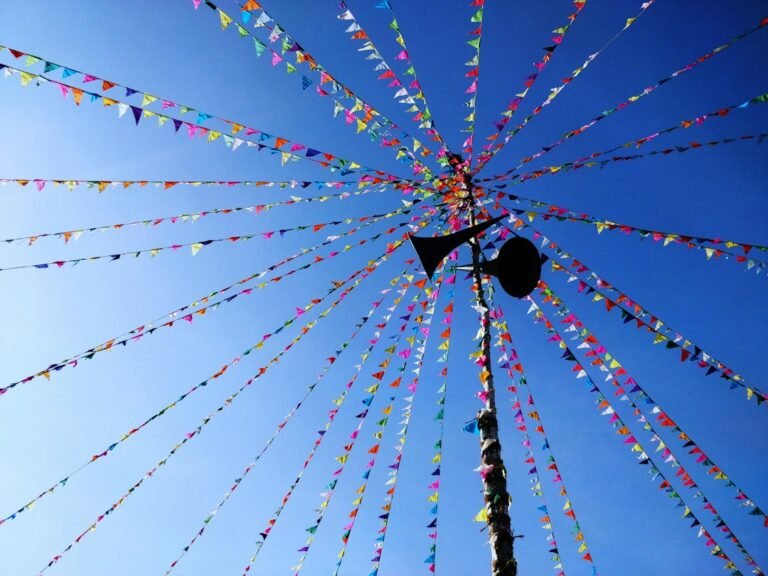
Day 1: Bhogi, Out With the Old
The day before Bhogi, families clean the whole house and set aside old, broken and unused things. Early on Bhogi morning, these are burned in a bonfire outside, a custom summed up in the Tamil phrase pazhayana kazhidhalum, puthiyana puguthalum (letting go of the old, letting in the new). Children traditionally beat small drums around the fire. Bhogi is also linked to Indra, the god of rain, who is thanked for a good season (eSamskriti on the four days of Pongal).
Many homes tie kappu at the entrance on Bhogi: a small bunch of neem leaves with avaram and poolai flowers, tucked into the roof edge or door frame to keep away harm in the year ahead. In cities, many families now skip the bonfire, or burn only a few dry leaves, because of air pollution.
Day 2: Thai Pongal, the Pot Boils Over
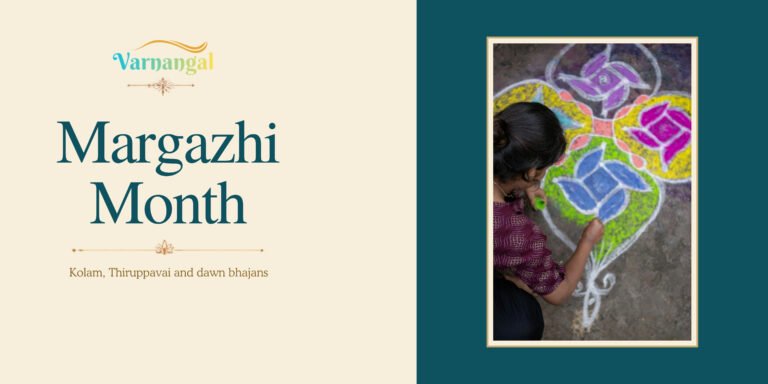
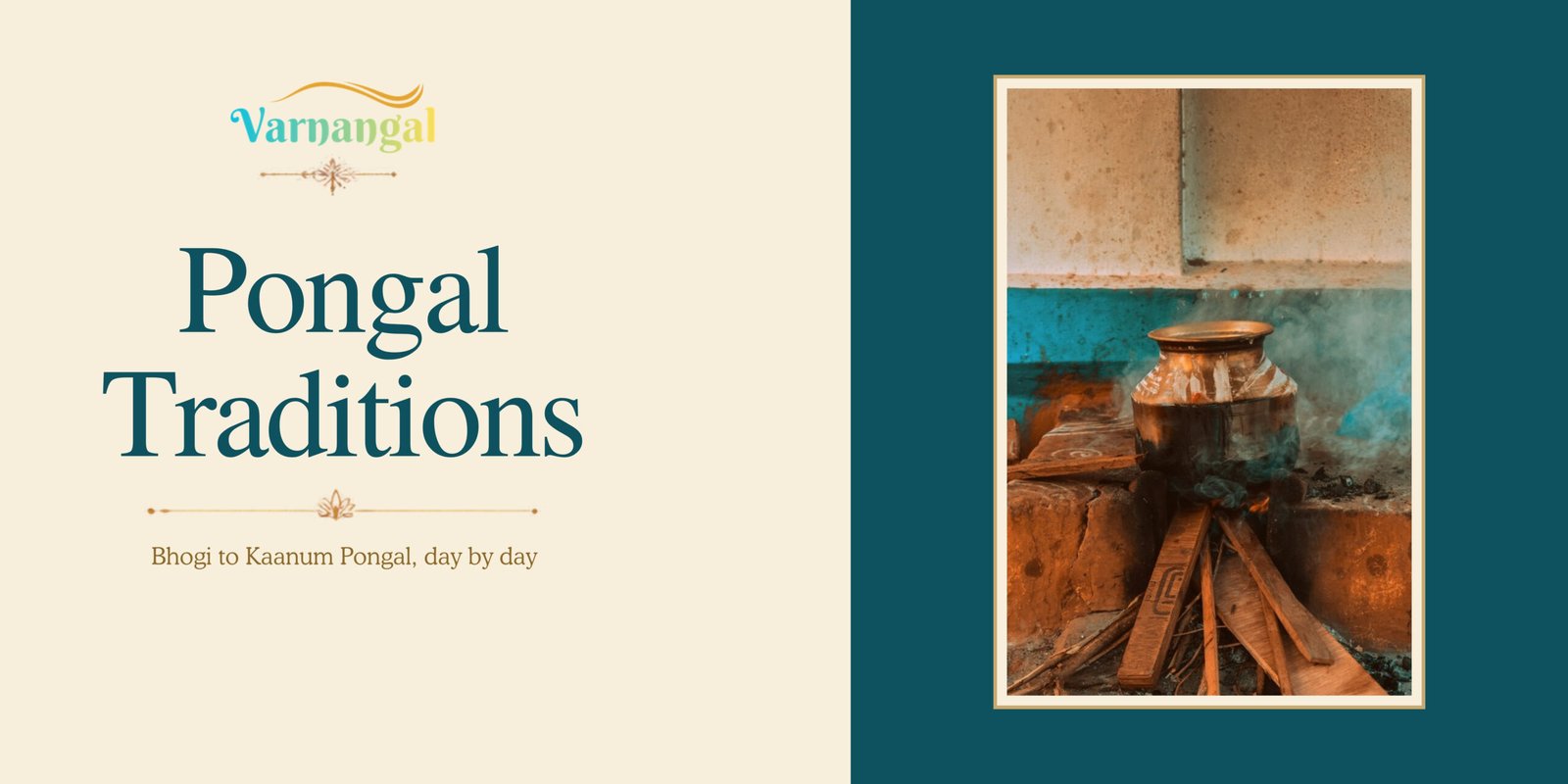
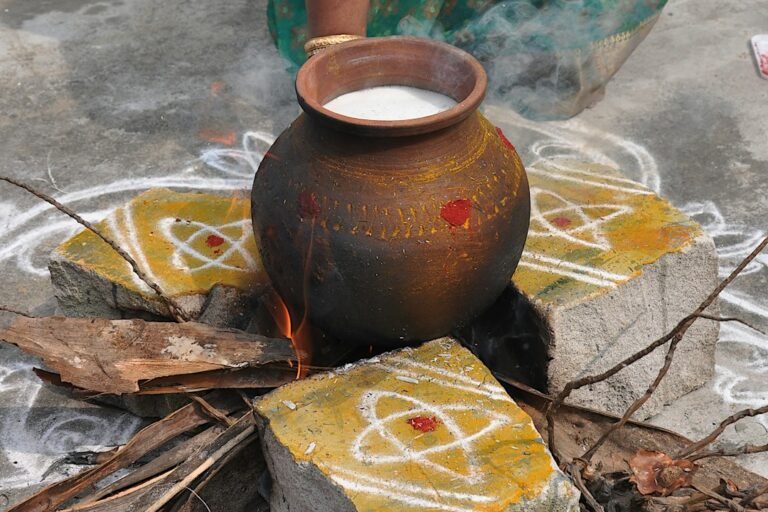
This is the main day. The front yard is cleaned and a kolam is drawn, often with a sun or a Pongal pot in the design. A new clay pot, or a bronze one (vengala paanai), is decorated with a turmeric plant tied around its neck and set on a fire outdoors, in the sunlight. Freshly harvested rice is cooked in milk.
The moment the milk froths over the rim, everyone calls out “Pongalo Pongal!”. The overflow stands for abundance in the coming year. Two dishes are made: sakkarai pongal (sweet, with jaggery, ghee and cashews) and ven pongal (savoury, with pepper and cumin). They are offered to the Sun on a banana leaf with sugarcane, bananas and turmeric, and then shared.
Day 3: Mattu Pongal, Thanking the Cattle
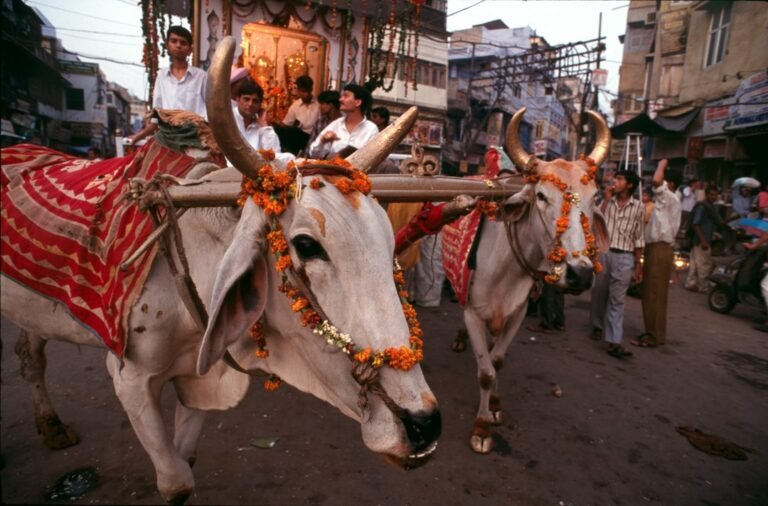
Mattu (cattle) Pongal honours the cows and bulls that plough the fields and give milk. They are bathed, their horns are painted in bright colours, and they are decorated with bells, garlands and new ropes. They are fed sakkarai pongal before anyone else eats (ParentCircle on Pongal customs).
Mattu Pongal is also the day of jallikattu, the bull-taming sport. The best-known events are held in villages around Madurai, such as Avaniyapuram, Palamedu and Alanganallur. Tamil Nadu also marks Thiruvalluvar Day, in honour of the poet of the Thirukkural, around this time.
On the same morning, women in many families perform Kanu Pidi. Rice coloured white, yellow (with turmeric) and red (with kumkum and lime) is shaped into small balls and placed on turmeric leaves for crows and birds, with a prayer for the well-being of their brothers.
Day 4: Kaanum Pongal, Seeing Family
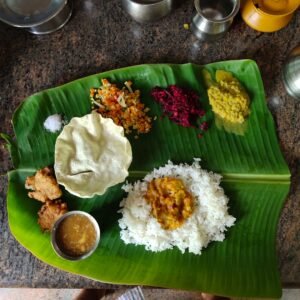
Kaanum means “to see”. On the last day, families visit relatives, younger members take blessings from elders, and people go out together. In Chennai, the Marina and Elliot’s beaches are packed with families on Kaanum Pongal. It is the day the festival opens outward, from the home and the farm to the whole community. Many families also sit down to a festive meal together, served on banana leaves.
Pongal and the Weaving Towns
Harvest festivals touch weaving towns too. eSamskriti notes that weavers in Arani stop work for about a week around Pongal, visit temples, and restart their looms on an auspicious day. New clothes are part of Thai Pongal in most Tamil homes, which is why handloom towns such as Arani and Thirubuvanam are busy in the weeks before the festival. If you want to know how the two weaves compare, read Thirubuvanam vs Arani silk sarees.
Pongal vs Other Harvest Festivals in India
Mid-January is harvest time across India, and the same turn of the Sun is celebrated under different names:
| Region | Festival | Known for |
|---|---|---|
|
Tamil Nadu |
Pongal |
Four days, the Pongal pot, cattle and family visits |
|
Most of India |
Makar Sankranti |
The same solar day, often with sesame and jaggery sweets |
|
Gujarat |
Uttarayan |
Kite flying |
|
Punjab |
Lohri |
A bonfire on the night before Sankranti, much like Bhogi |
|
Assam |
Magh Bihu |
Community feasts and bonfires |
What sets Pongal apart is that it is named after the dish at its centre, and that it gives a whole day to the cattle.
Conclusion
Pongal moves from the house to the field to the street over four days: the Bhogi fire clears out the old, the Thai Pongal pot boils over for the Sun, the cattle are thanked on Mattu Pongal, and the family comes together on Kaanum Pongal. In January 2027, when you hear “Pongalo Pongal!”, you will know what each day stands for.
Frequently Asked Questions (FAQ)
What are the 4 days of Pongal?
Bhogi (clearing out old things and a bonfire), Thai Pongal (cooking Pongal for the Sun), Mattu Pongal (honouring cattle) and Kaanum Pongal (visiting family and going out).
When is Pongal in 2027?
Thai Pongal is expected on Friday 15 January 2027, with Bhogi on 14 January, Mattu Pongal on 16 January and Kaanum Pongal on 17 January. Confirm with the Tamil Nadu holiday list or a panchangam.
Why do we say Pongalo Pongal?
The words are called out when the milk and rice boil over the rim of the pot on Thai Pongal. The overflow stands for abundance, and calling out marks the most auspicious moment of the festival.
Pongal festival is celebrated in which state?
Pongal is mainly celebrated in Tamil Nadu and Puducherry, and by Tamil communities in Sri Lanka, Malaysia, Singapore and elsewhere. The same solar festival is called Makar Sankranti in much of India.
What is Kanu Pidi?
Kanu Pidi is a ritual on Mattu Pongal morning in which women place coloured rice balls on turmeric leaves for crows and birds and pray for the well-being of their brothers.
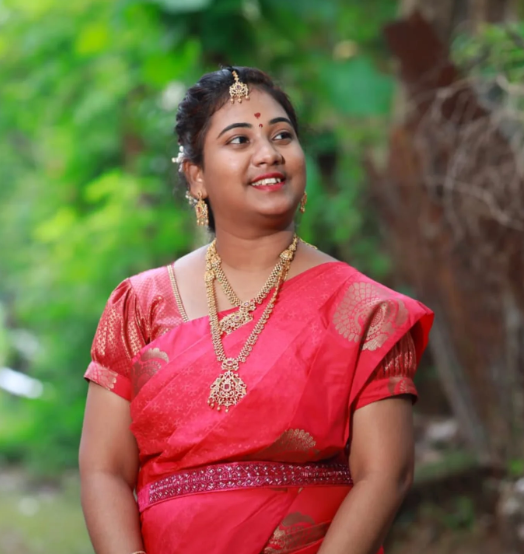
Abirami R – I grew up watching the women in my family drape themselves in vibrant colors, which made me realize that a saree carries both grace and history. With my husband Rajarajan’s encouragement, I turned this fascination into a mission to help you find truly authentic Tamil Nadu weaves. I’ve spent years learning the technical side, like zari weight and thread strength, to protect you from misinformation and help you find pieces worth passing down. My goal is to teach you the soul of the heavy Thirubuvanam silk saree so you can identify a real masterpiece for yourself.